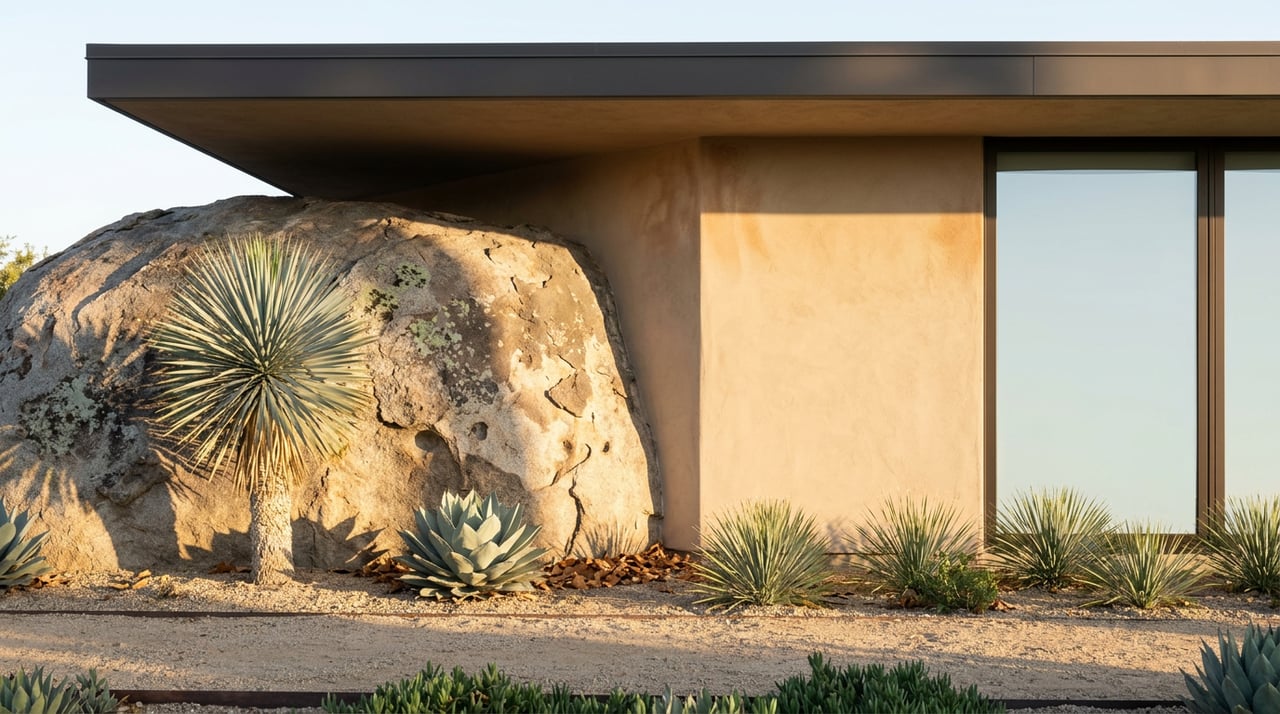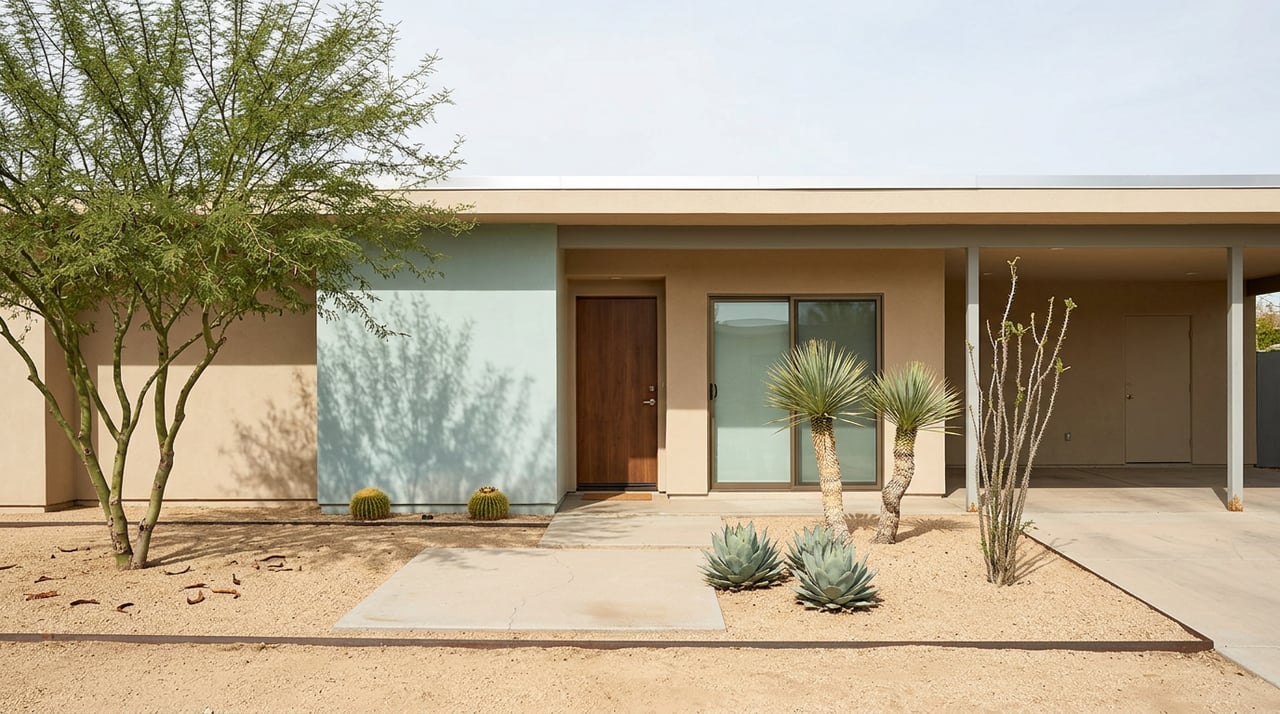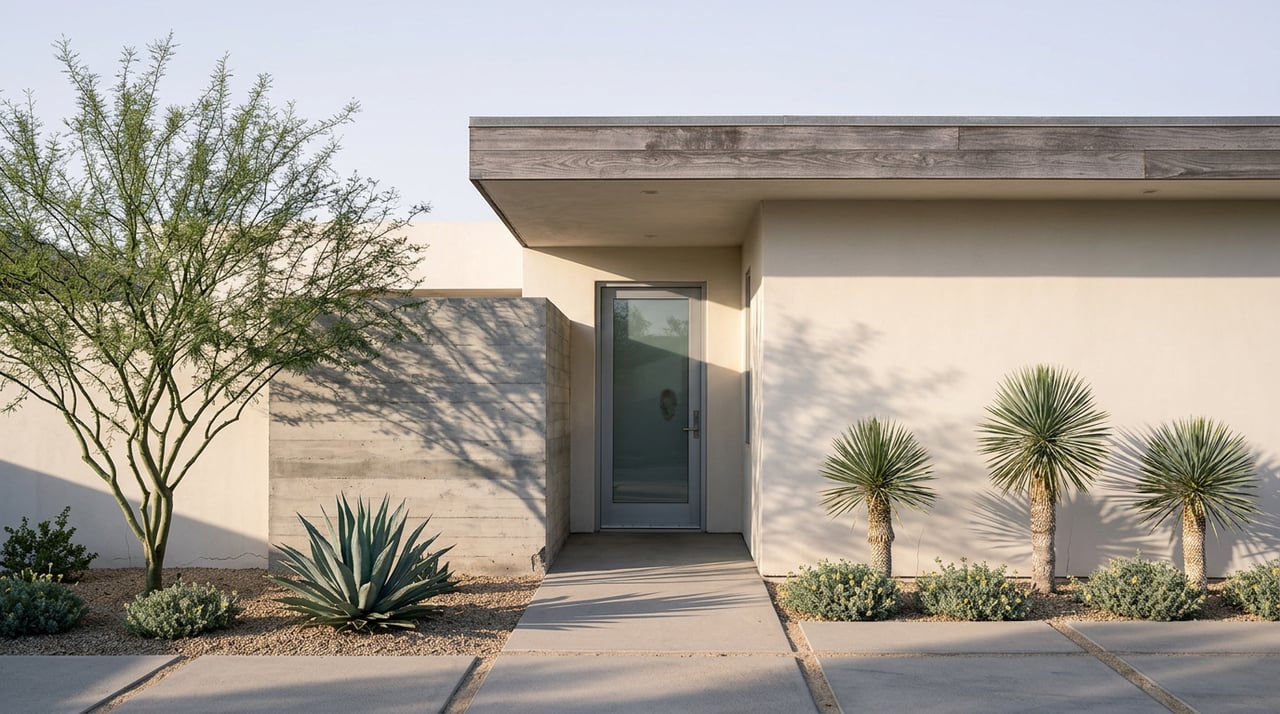
Why would two nearly identical homes, four doors apart on the same Indian Canyons street, list for prices that differ by hundreds of thousands of dollars?
Same era of construction. Same golf course backdrop. Same walk to the clubhouse. On the portal, the cheaper one looks like the obvious buy. In practice, it can end up costing more to own over a decade than its pricier neighbor. The gap almost never comes down to the house. It comes down to a question the listing sheet rarely answers in plain language: who owns the ground the house sits on, and on what terms.
Whose Dirt Is It, Anyway
Indian Canyons sits inside a pattern drawn by the federal government in 1876, when alternating square-mile sections of the Coachella Valley were handed to the Pacific Railroad and to the Agua Caliente Band of Cahuilla Indians as the railroad pushed its line between Los Angeles and Yuma. The tribe ended up with roughly 52,000 acres across the valley, about 6,700 of them inside Palm Springs city limits. That checkerboard still shapes ownership today, and it means a meaningful share of Indian Canyons homes sit on land the homeowner does not own outright.
Some parcels here are fee simple, meaning you own the dirt as well as the structure. Others sit on Agua Caliente lease land, where the tribe or an individual tribal allottee owns the ground and the homeowner pays annual rent for the right to occupy it. Communities like Canyon Estates, Canyon View Estates, and Kings Point carry lease terms that run into the 2060s and 2080s, and much of the neighborhood's development, including work tied to Fey's Canyon, was structured as a sandwich lease, where a developer holds the underlying lease from the tribe and subleases it to homeowners at a markup. That extra layer matters later, because it means a homeowner negotiating a renewal isn't always dealing directly with the landowner. They're dealing with whoever holds the master lease in between.
The Discount Is Real, and So Is the Catch
The financial logic of lease land is straightforward on paper. Because you're buying only the structure and not the ground beneath it, homes on leased land in the Coachella Valley typically list for 15 to 30 percent less than comparable fee simple properties. That discount is why lease land has long been a way for buyers to get into an architecturally significant Indian Canyons address, a Krisel-designed floor plan or a Boris Gertzen fireplace wall, at a price a fee simple lot in the same location wouldn't allow.
The catch is that the lease itself isn't a fixed cost. It's a contract that eventually comes up for renewal, and unlike a property tax rate or an HOA schedule, the terms of that renewal are set individually, family by family, lease by lease. There's no valley-wide formula. What one landowner offers a community has almost nothing to do with what another landowner, holding a different parcel a mile away, decides to offer theirs.
That variability stopped being theoretical in the past year. A News Channel 3 I-Team investigation that began in July 2025 followed a dispute at Saddlerock Estates, a south Palm Springs community built on Agua Caliente lease land under a master lease dating to 1977 and set to expire in 2042. The landowner proposed a new successor lease running 52 years past that date, with an immediate monthly increase of $450 on top of the $200 homeowners were already paying, escalating another 20 to 30 percent every five years after that, plus a signing fee of $100,000 per unit due by the end of 2025. Homeowners pushed back through Hallview, the management company tied to the master lease, which filed a formal appeal with the Bureau of Indian Affairs in February 2026 arguing it had been cut out of a negotiation it should have had standing in. In May 2026, a tribal court dismissed the landowner's countersuit against Hallview, though the larger fight over the lease terms themselves is still unresolved.
Compare that to Sunshine Villas, a community built in the same era under a different landowner. Its lease was renewed through 2076 for a one-time fee of just $10,000, with the monthly rate stepping up to $662 only when the new term takes effect in 2042.
| Saddlerock Estates (proposed) | Sunshine Villas (executed) | |
|---|---|---|
| Original master lease | 1977, expires 2042 | Same era |
| Signing fee | $100,000 per unit | $10,000 one time |
| New term | 52 years past 2042 | Through 2076 |
| Monthly rate | $450 immediate increase over existing $200, then 20-30% every 5 years | $662 starting 2042 |
| Status as of May 2026 | Disputed, in federal and tribal proceedings | Finalized |
Same era, same tenure structure, two entirely different outcomes, because two different landowners made two different decisions.
Why This Is an Indian Canyons Problem, Not Just a Saddlerock One
Saddlerock isn't inside Indian Canyons. But the mechanism it exposed runs directly through the neighborhood. Indian Canyons leases were negotiated by different families with different developers across different decades, exactly the same fragmented structure that produced two opposite outcomes for Saddlerock and Sunshine Villas. A lease with 42 years remaining behaves like any other listing in the buyer pool. A lease with 22 years remaining is a much smaller market, and what happens when that lease comes up for renewal depends entirely on which family holds the parcel and how the sandwich lease, if there is one, gets renegotiated in the middle.
This is worth sitting with if you're drawn to Indian Canyons for the reason most buyers are: the architecture. Homes here carry design pedigree from William Krisel, Stan Sackley, Donald Wexler, and Boris Gertzen, the same names that define Palm Springs modernism at its best. A Krisel post-and-beam with an intact original roofline is a genuine find. But the lease sitting underneath it is a separate asset with its own expiration date, its own administrator, and its own renewal risk, and that risk doesn't care how well the house was restored.
What This Changes About How You Shop
None of this is a reason to avoid Indian Canyons. It's a reason to shop it differently than you'd shop a fee simple neighborhood. A few mechanics worth knowing before you write an offer:
- Financing has a hard floor. Lenders generally want the remaining lease term to outlast your mortgage term by about five years. A 30-year loan wants at least 35 years left on the lease. A 15-year loan wants 20. Fall short and your options narrow to a shorter amortization, a local portfolio lender, or cash.
- Appraisals don't behave like fee simple comps. Appraisers weight recent trades inside the same lease window, which is a large part of why straightforward per-square-foot comparisons break down on lease parcels. Two homes with identical finishes can appraise differently if their leases sit at different points in the cycle.
- Sandwich leases add a negotiating layer. If your parcel runs through a developer sublease, such as those tied to Fey's Canyon, you're not negotiating extensions directly with the tribal landowner. You're negotiating with the sublessor, and that middle party's own agreement with the landowner shapes what they can offer you.
- Closing takes longer than a standard escrow. Trust land transfers require an application through the tribal land records process, with a standard review window of about ten business days and rush processing available for an added fee. Build that into your calendar before you set a close date.
- Ask for the lease file before you fall for the house. Expiration year, current annual rent, escalation schedule, renewal history, and whether the arrangement is a direct lease or a sandwich lease. A listing agent should be able to answer all five in one conversation.
The Two Prices on Every Sign
Go back to those two homes on the same street. The cheaper one isn't the better deal until you know where its lease sits in its cycle and who's on the other side of the renewal conversation. The pricier one isn't overpriced if it's fee simple and you're planning to hold for thirty years. Neither number tells you anything by itself. Read together, with the lease file in hand, they tell you the whole story.
Does every home in Indian Canyons sit on leased land? No. The neighborhood contains both lease land and fee simple parcels, sometimes within the same street or the same condo tract. Verifying which one applies to a specific address is a task for your agent and the title report, not an assumption based on the neighborhood name.
Can I get a standard 30-year mortgage on a lease land home here? Often, yes, provided the lease has enough years remaining to clear the five-year buffer most lenders require. If it doesn't, expect a shorter loan term or a lender that specializes in lease land financing.
Does a lease land home appreciate differently than a fee simple one? Both track the broader Palm Springs market, but a lease approaching its renewal window can trade at a discount to an identical home with decades left on its term, which is exactly the gap that makes two similar-looking listings price so differently.
If you're weighing an Indian Canyons home, whether it's a Krisel original on fee land or a fairway property with a lease file worth reading closely, Richie Usher can walk the lease history and the architecture side by side before you write an offer. Find Your Palm Springs Modern Home.