Walk out from the Palermo and Tuscan streets grid before seven in the morning this week and you'll notice something that wasn't part of the neighborhood's story less than two years ago: a footpath off West Racquet Club at Leonard leading to a piece of public art called FossilOPs of the Future, set into a stretch of hillside that spent two decades as a construction site nobody could agree on.
That hillside has a name now. It's called Crescendo, and it belongs to the city of Palm Springs permanently. The story of how it got there, and why it matters more in late August than it did in January, says more about how Little Tuscany actually functions than another paragraph about Richard Neutra ever could.
Twenty Years Over Two Vacant Lots
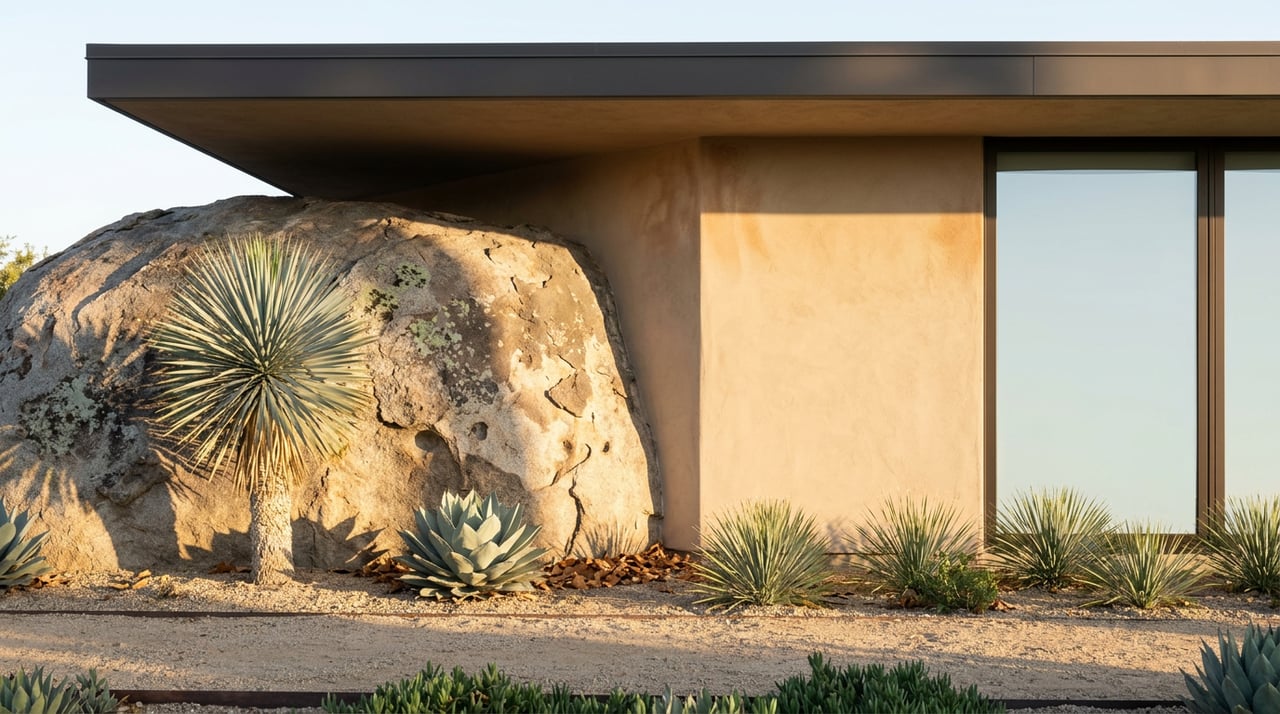
Little Tuscany sits on the west side of Palm Canyon Drive, north of Vista Chino, in the hills that builder Alvah Hicks first developed after a trip to Italy in 1934. He built seven Tuscan-style homes into the boulder-strewn hillside and gave the streets their names: Palermo, Girasol, Tuscan, Via Olivera, Cardillo. Plans from the 1940s referred to the whole area as Piemonte Estates before Little Tuscany stuck.
That founding story gets told often. What doesn't get told as often is what happened to two parcels bordering the neighborhood that developers spent close to twenty years trying to build on.
The parcels, known by the developer's own working names as Boulders and Crescendo, were previously owned by Grit Development, formerly Wessman Development. They were conveyed to the city of Palm Springs in 2019 as part of a settlement in an unrelated lawsuit over downtown redevelopment. City Council members said at the time they were open to designating the land as permanent open space, but nothing was finalized, and the parcels sat in limbo while neighbors worried a future council could reverse course and sell them off for denser housing.
That changed in January 2025, when the Palm Springs City Council adopted an update to the city's General Plan and formally designated Boulders and Crescendo as open space in perpetuity. Coverage from the Palm Springs Post credited District 2 Councilmember Jeffrey Bernstein for pushing the designation through, alongside Planning Director Chris Hadwin, who presented the update after years of community input.
Little Tuscany resident Tim O'Bayley, who led the fight to protect the land, put the outcome plainly in a piece for the Coachella Valley Independent:
"a better housing product with less density that was more consistent with the neighborhood."
That's the quiet version of what happened. The louder version is that a small group of homeowners outlasted a developer, two name changes, and a city council that took years to formalize what it had already agreed to informally.
What "Permanent" Actually Required
California housing law doesn't let a city simply remove land from the development pipeline without accounting for it somewhere else. To satisfy the state's Housing Element requirements, Palm Springs designated a separate parcel on Gene Autry Trail, north of Mission Drive, as high-density residential, absorbing the housing units that would otherwise have gone on Boulders and Crescendo.
That's the mechanism most residents never see: the open space you walk through didn't just get protected, it got traded. Somewhere across town, a different parcel is now zoned to carry the density that used to threaten this hillside. Little Tuscany didn't get a favor. It got a swap, and the swap held.
The Walk Itself
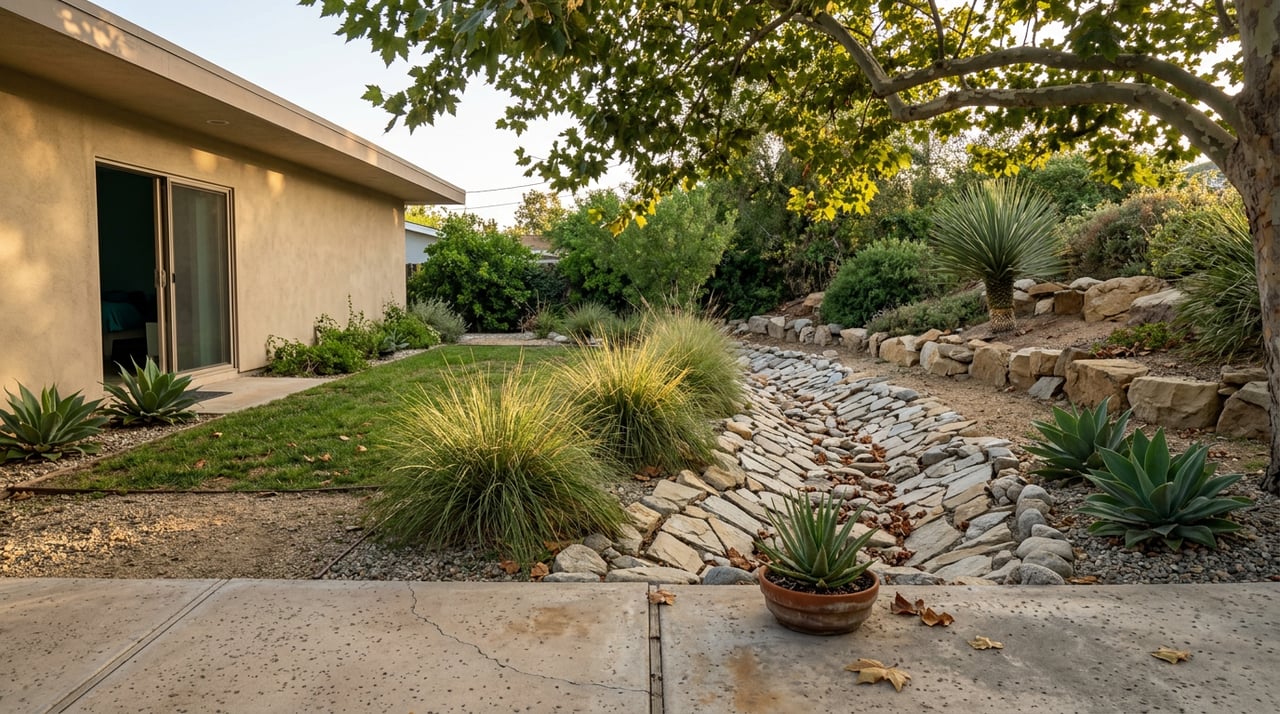
Crescendo occupies part of Chino Canyon's alluvial fan, the sloped apron of sediment washed down from the canyon over thousands of years, running between West Racquet Club and Tram Way. Boulders sits along Chino Canyon Road, preserving the boulder-heavy terrain that gave the original 1930s development its character.
The path to Crescendo runs off West Racquet Club at Leonard, a short, quiet stretch that most visitors to Palm Springs will never find because it isn't listed on any trail app. At the end of it is FossilOPs of the Future, installed by Tyler Burton, a Little Tuscany resident and local artist, and recognized by the Palm Springs Public Arts Commission. It's not a destination hike. It's closer to a five-minute detour that turns an ordinary morning loop into something with a stopping point.
For residents used to thinking of Little Tuscany's outdoor identity as strictly the domain of Chino Canyon Trail and the tramway above it, Crescendo is a different kind of amenity: flat, close, and immune to the seasonal shutdowns that govern the canyons.
Why This Walk Matters More in Late August
Here's the part that makes the timing relevant instead of merely historical. In early August, the Palm Springs Fire Department issued a citywide warning urging hikers to stay off trails during peak heat, after responding to a run of heat-related medical calls through the summer. The department's guidance, reported by NBC Palm Springs, was straightforward: start early, avoid the afternoon entirely, and never assume a short trail is a safe trail once the temperature climbs.
That guidance applies to any canyon-adjacent route in the city, including the terrain above Little Tuscany. It doesn't mean the neighborhood's outdoor life shuts down for the summer. It means the calculus changes. A loop that includes Crescendo works within the fire department's own timing advice in a way a canyon ascent doesn't:
- It's flat enough to finish before 7:30 a.m. without rushing.
- It has no elevation gain, which matters when heat stress builds faster on a climb.
- It ends at a fixed point, so there's no temptation to keep going once the sun clears the ridge.
- It connects directly back to North Palm Canyon Drive, where Bread and Flours, the sourdough bakery run by Mark and Kristin Gavigan, opens its retail counter on Wednesday through Saturday mornings.
None of that existed as a coherent loop before January 2025. It existed as a construction dispute, a fenced lot, and a trailhead that led nowhere official.
The Older Story Underneath the New One
Chino Canyon Trail itself has a history worth knowing, separate from the recent land fight. The trail has been maintained since 1931 by the Desert Riders Equestrian Club, whose early membership included Clark Gable, Olivia de Havilland, Carl Lykken, Charlie Farrell, Henry Fonda, and Cary Grant. That's nearly a century of continuous use by a private club, long before Little Tuscany's boulder-strewn hillside brought in mid-century architects looking for terrain that would fight back against a flat floor plan.
The contrast is worth sitting with. Chino Canyon Trail survived because a private group kept showing up to maintain it for generations. Boulders and Crescendo survived because a different group of residents showed up to city council meetings for twenty years and refused to let a settlement agreement quietly become a subdivision. Different eras, same instinct: the neighborhood's outdoor character has never been passive. Someone has always been maintaining it, on purpose, against the alternative.
What This Actually Tells You About the Neighborhood
It would be easy to file this under parks news and move on. But the more useful read is that Little Tuscany's civic identity runs on the same volunteer infrastructure as its walking trails. The Little Tuscany Neighborhood Organization, the group that tracked the Boulders and Crescendo fight from settlement to General Plan adoption, still runs on residents who show up to board meetings, advocate on zoning questions, and organize the kind of newsletter updates that turn a city council vote into something the whole block understands.
That's not a detail that shows up on a listing sheet. But it's the reason a walk to a piece of public art on a formerly contested hillside now feels like a permanent part of the neighborhood rather than a temporary workaround. Twenty years of persistence bought something residents will use for decades: a short, flat, shaded-enough loop that works in August when the canyon doesn't, ending at a bakery counter that's become part of the morning routine for a lot of Little Tuscany households.
If you're already living the daily rhythm of Little Tuscany, that's the kind of detail worth knowing before your neighbor mentions it first. And if design history and civic persistence are both part of what draws you to a neighborhood like this one, Richie Usher Realty Group has spent years tracking exactly this kind of local detail across Palm Springs. Find Your Palm Springs Modern Home.