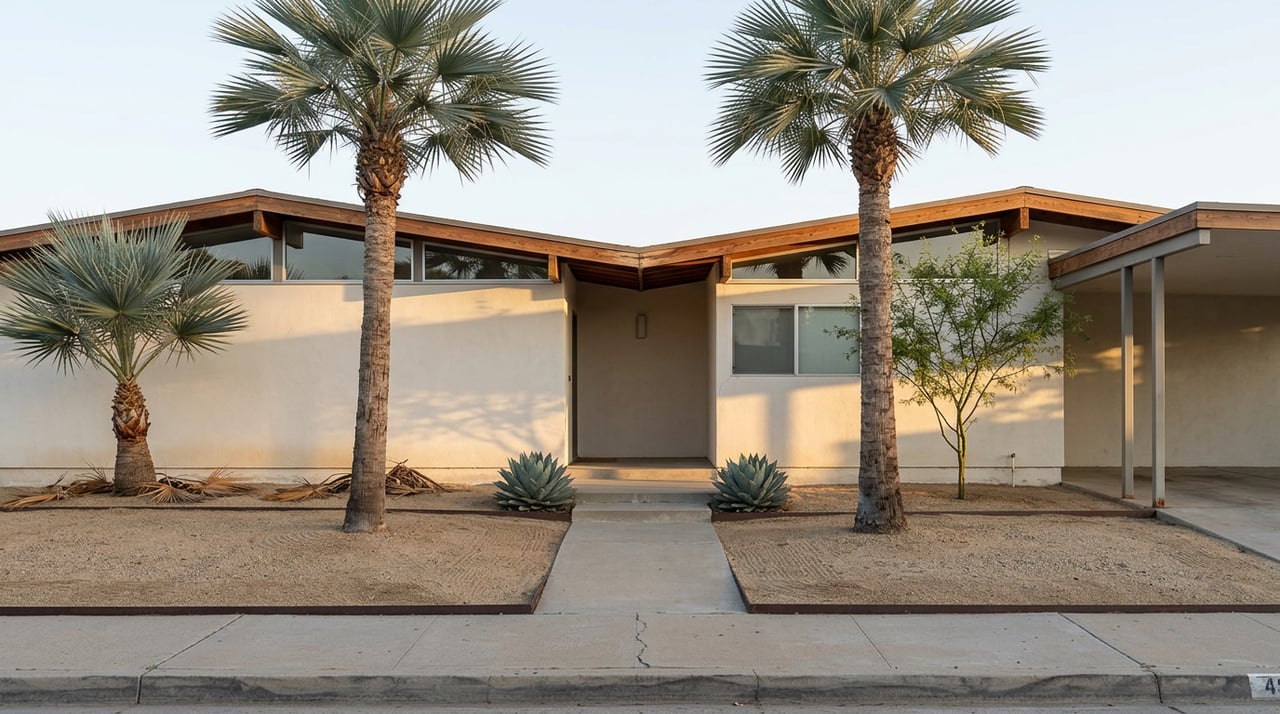
Search "Twin Palms Palm Springs" this week and the internet will send you to two different addresses. One is a private residence on East Alejo Road in Movie Colony East, a piano-shaped pool and a 1947 E. Stewart Williams design that Frank Sinatra commissioned after his architect talked him out of the Georgian brick mansion he originally wanted. The other is roughly a mile and a half south, a tract of more than ninety homes built by the Alexander Construction Company starting in 1956, where you live.
The overlap in names is not a coincidence exactly, but it is not a connection either. Sinatra named his house for the two palm trees planted beside it. A decade later, when George and Robert Alexander built their first Coachella Valley subdivision, every single lot got the same two-palm treatment in the front yard, a detail formal enough to earn its own name: the Twin Palm Designation. Two different men, two different decades, the same modest landscaping idea, and now one search query that can't tell them apart. Even the walking-tour operators have had to start adding disclaimers. A private guide's listing for the neighborhood tour spells it out directly: "Tour is not of Frank Sinatra's former residence named 'Twin Palms.'"
If you live on Apache Road or Navajo Circle, you have probably fielded this question from a confused dinner guest or a rideshare driver following bad directions. Here is the short version worth keeping in your back pocket.
Two Twin Palms, One Overlapping Name
| Twin Palms Estates (your neighborhood) | "Twin Palms" (the Sinatra house) | |
|---|---|---|
| Location | South Palm Springs, between Camino Real and La Verne Way | 1148 East Alejo Road, Movie Colony East |
| Built | 1956 to roughly 1959, in three phases | 1947 |
| Architect | William Krisel, working with Dan Palmer for the Alexander Construction Company | E. Stewart Williams, his first residential commission |
| What it is | A full tract of more than ninety single-family homes | One private, 4,500-square-foot residence |
| Getting in | Free, any day, on public streets. The neighborhood association runs occasional resident-led walks | Ticketed. Booked through the property's hospitality operator or as part of a scheduled festival tour |
The two properties share nothing but a landscaping habit and a name. It is worth saying plainly, because most of what gets written about your neighborhood skips this part and jumps straight to the butterfly roofs.
Why Every Yard Got the Same Two Trees
The butterfly roofs get the photography, but the two palms are the detail that actually explains how this neighborhood works. Krisel's assignment from the Alexanders was a hard problem: build ninety-some homes off a nearly identical floor plan, cheaply enough to sell to middle-income buyers, and make none of them look like the others. His answer was to rotate the same square plan on each lot, vary the entry orientation, and swap in different roof profiles, gable here, butterfly there, so no two neighbors faced the street the same way. The project's original working name, before the palm trees gave it a better one, was Smoke Tree Valley Estates.
The twin palms were the piece that tied all those variations back together. Whatever roofline a given house got, whatever direction its carport faced, the same two trees stood out front, planted at the same time the concrete cured. Walk Apache Road or La Jolla Road today and that is still the detail your eye catches before the roof does: a matched pair, repeating down the block, the one constant in a neighborhood built specifically to look inconstant.
It is a small thing to have survived nearly seventy years of resales, remodels, and at least one round of homes altered past recognition, but it has. That kind of quiet continuity is part of the neighborhood's character.
The Group That Keeps Score
The Twin Palms Neighborhood Organization has a looser arrangement than most homeowner groups. Anyone living, owning property, or running a business in the neighborhood is automatically a member. Dues are twenty-five dollars a year, and they are voluntary.
What that low bar buys is a genuinely active calendar. The group's general membership meetings happen at the Ocotillo Lodge Clubhouse, the same hotel-resort the Alexanders built first to host prospective buyers touring Twin Palms homes back in the 1950s. The most recent meetings have brought in people whose job is to know what is actually happening in the neighborhood: a November 2025 fall meeting featured Palm Springs Battalion Chief Matthew MacLean and Councilperson David Ready, and the January 2026 social meeting turned into ten rounds of bingo hosted by a volunteer going by Bella da Ball. It is not a glossy operation. It is a room full of neighbors, in the clubhouse their neighborhood was quite literally built around, doing the unglamorous work of keeping a historic tract functioning as a community rather than a museum.
That distinction matters more than it sounds like it should. A lot of mid-century neighborhoods get preserved as scenery, something to drive through and photograph. Twin Palms gets preserved as a place people still run into each other.
Why October Belongs to This Neighborhood
The clearest proof that the effort is working shows up on Modernism Week's calendar. The festival's October 2026 event runs October 15 through 18, and this year the neighborhood is not a stop on a bus tour. It is the headline. A 1957 post-and-beam home in Twin Palms, reimagined by H3K Home + Design and now known as The Marquee at Twin Palms, has been named one of the festival's two Featured Home Tours for the October event. Tickets are already on sale.
Getting picked as a Featured Home Tour is a different kind of recognition than making the neighborhood-tour circuit. It puts a Twin Palms address in the same conversation as Albert Frey's own house and the Kirk Douglas estate, houses that carry a single famous name. The Marquee earns its slot the other way, as one property standing in for the whole tract's particular trick: take a modest, repeatable design and give it enough individual character that sixty-nine years later, festival programmers are still choosing it to represent the best of what desert modernism can do with an ordinary lot.
The neighborhood also currently holds two pieces in the City of Palm Springs' public art collection, a fact easy to miss on a normal afternoon walk but one more thread in the same story: this is a place whose civic identity keeps getting built from small, deliberate additions rather than one grand gesture.
What Actually Explains the Neighborhood
None of this is really about Sinatra, and that is the point. His Twin Palms is a single house with a single famous owner, preserved because of who lived there. Yours is the opposite kind of landmark: a whole tract that stayed legible because dozens of owners, one clubhouse meeting at a time, kept the shared parts of it intact. Same two trees, different math entirely.
Next time someone asks whether you live in the house with Frank Sinatra's piano-shaped pool, you now have the better answer. You live in the neighborhood that gave the name its second, and more durable, meaning.
If a question about your own home's design lineage, a restoration detail on a butterfly roof, or the practical side of caring for a mid-century property in this specific pocket of Palm Springs ever needs an answer from someone who actually specializes in this architecture, Richie Usher Realty Group is a call away. No pressure to do anything with the conversation except get it right.