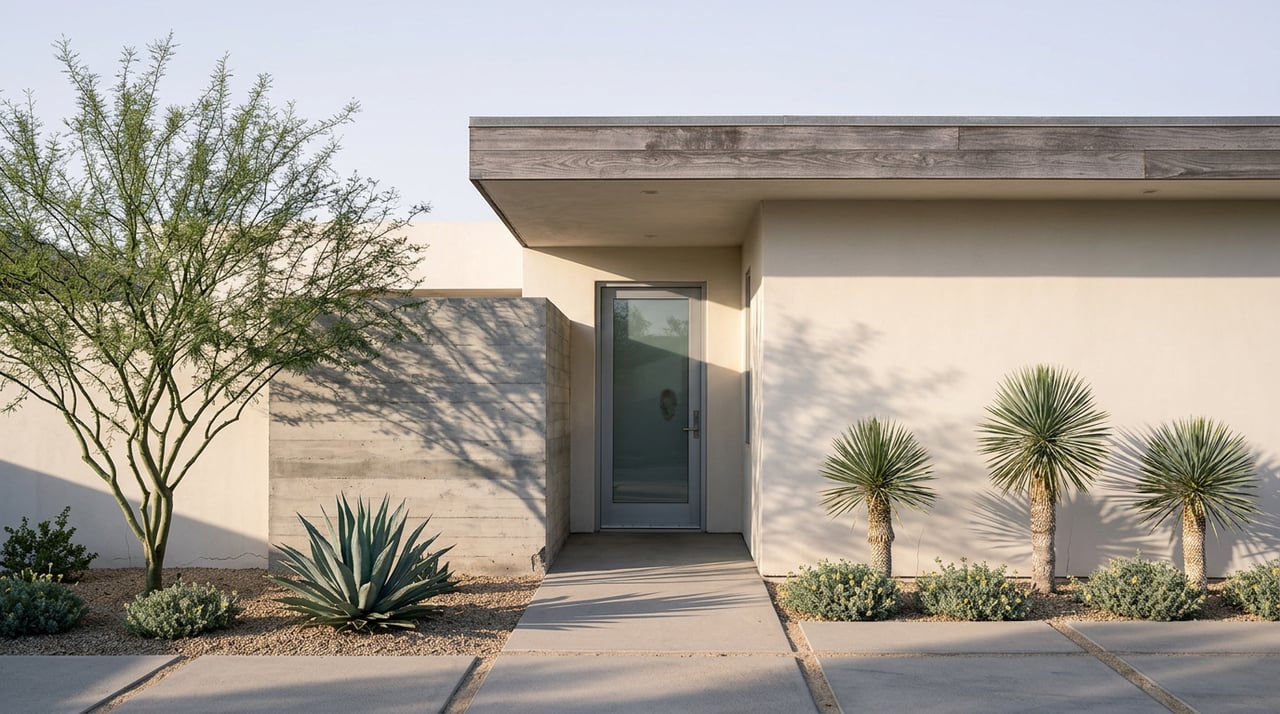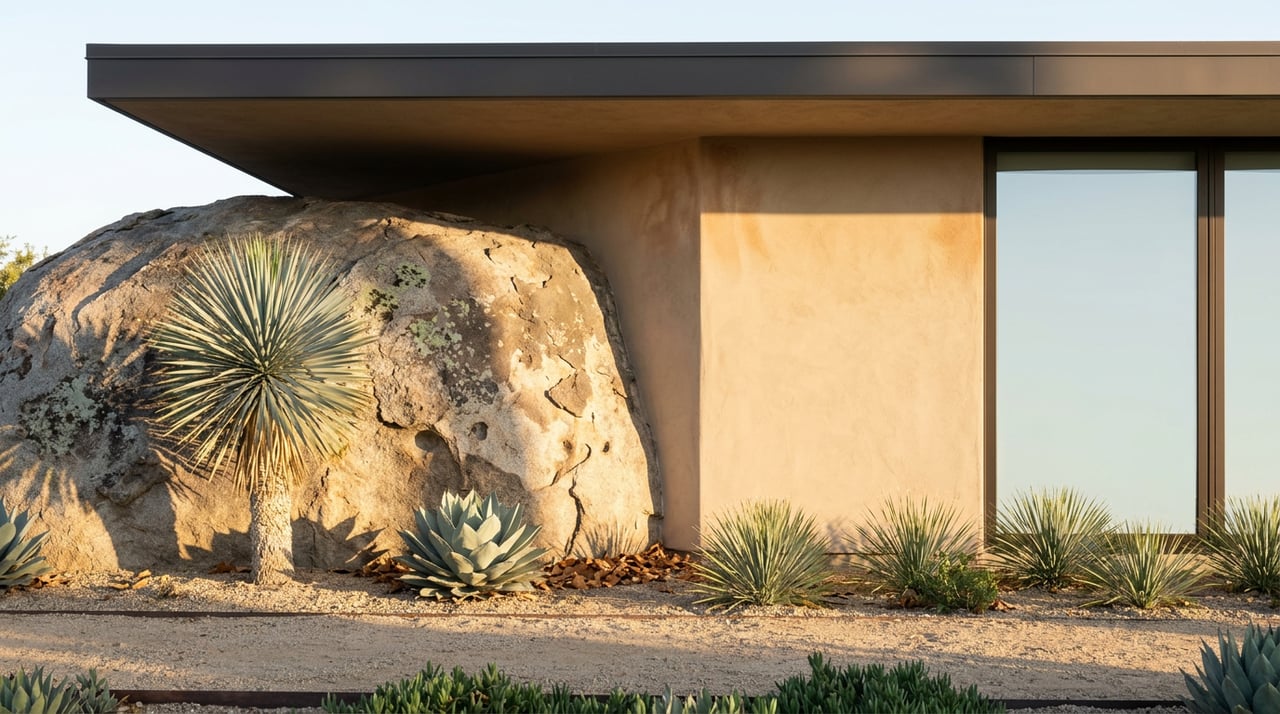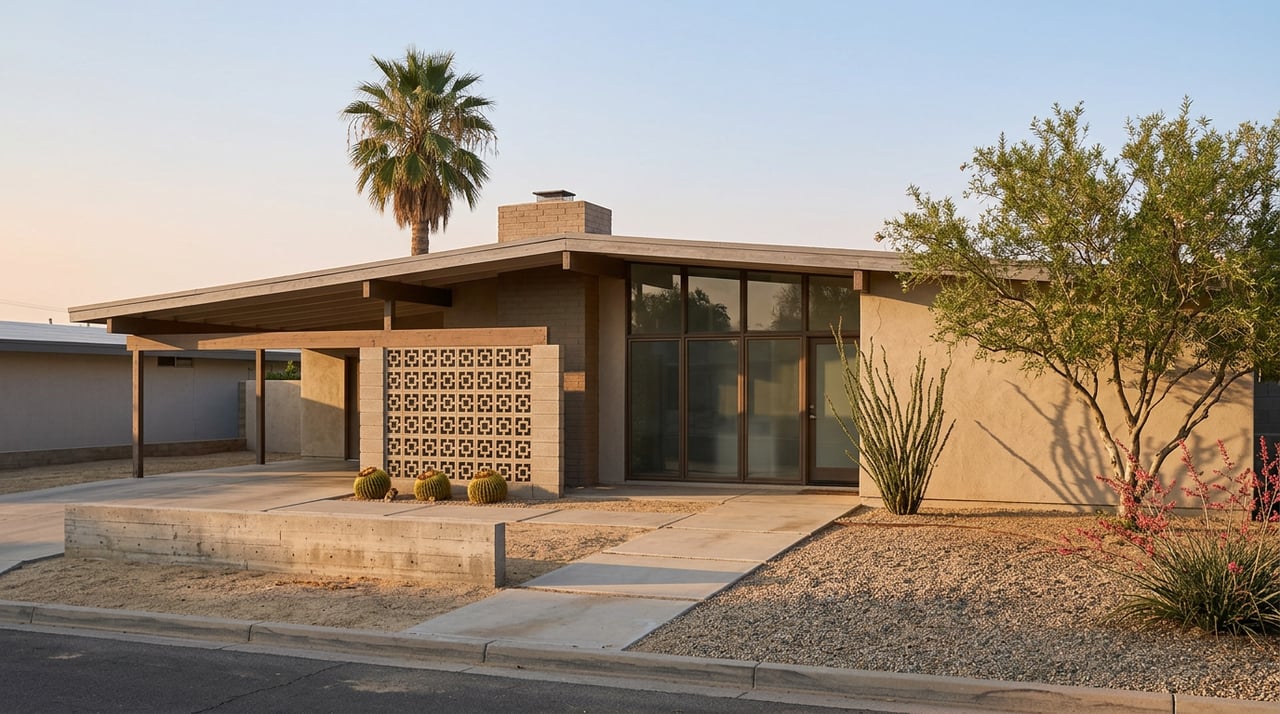
Two houses face each other across La Jolla Road in Twin Palms. Same butterfly roofline. Same 1,600-square-foot Krisel floor plan. Same year, give or take a season, since the Alexander Construction Company built this entire tract off a handful of interchangeable designs rotated across the lots. If you stood at the curb, you could not tell which house is which.
One of them cannot have its windows touched without a permit from the city that goes beyond the ordinary building department sign-off. The other can be remodeled tomorrow with nothing more than a standard permit. Nothing on either listing sheet tells you which is which, and the difference has nothing to do with the house. It has to do with a City Council resolution that was passed for one specific address and never for the other.
What Twin Palms Actually Is
Twin Palms Estates was the Alexander Construction Company's first subdivision in the Coachella Valley, commissioned in 1956 and developed through 1957 and 1958. It started life under a different name, Smoke Tree Valley Estates, before the developers planted two palm trees in front of every house and the name that stuck took over. William Krisel designed the tract with Dan Palmer, working from a single base plan of roughly 1,600 square feet that they rotated, mirrored, and dressed with alternating facades and rooflines so that no two houses on a block looked quite the same, even though the bones underneath were nearly identical. The homes were built post-and-beam, which let interior walls come down without touching structure, and the HVAC ducting ran through the slab, which is part of why the clerestory windows and open rooflines could exist at all.
That sameness was the point. It is also exactly what makes the ownership status of any given house invisible from the street.
The Rule Nobody Reads Until They Need It
Palm Springs protects historic homes one parcel at a time. A property earns Class 1 Historic Site status only through a resolution of the City Council, after a nomination, a staff review, and a vote by the Historic Site Preservation Board. Twin Palms Estates as a tract has never been swept into that designation wholesale. Instead, individual houses inside it have gone through the process on their own, while their neighbors have not.
The practical difference shows up at the permit counter. Once a house carries Class 1 status, the city's ordinance requires the owner to obtain a Certificate of Appropriateness before any building, zoning, or other development permit tied to a change that touches a character-defining feature, which for an Alexander typically means the roofline, the glazing, and the original facade. An undesignated house next door with the identical floor plan answers to none of that. Its owner can swap out original steel-frame windows for something modern with a standard permit and no additional review.
Two Addresses, Same Plan, Different Status
Chris Menrad bought his Alexander at 1070 E. Apache Road in 1999 without fully grasping what he had. It took about a year, and a 2000 feature in Flaunt magazine built around Julius Shulman's black-and-white photographs of the original Krisel houses, for the significance to click. Menrad spent the years that followed restoring the house with help from Palm Springs' architecture community, including architect and artist Phillip K. Smith III, who rebuilt the kitchen cabinets in birch plywood with surface-mounted hardware to match how they were actually built in the 1950s rather than the flush European style that had replaced them.
When Menrad applied for Class 1 status, Krisel himself endorsed the nomination in a 2009 letter, calling it, in his own words, "the best restoration of one of my houses designed for the Alexanders." The house is now catalogued by the neighborhood's own preservation group as Class 1 Historic Site No. 74.
It is not the only one on the books inside the tract. The Twin Palms Neighborhood Organization's home tour materials also list 992 E. La Jolla Road as Class 1 Historic Site No. 85, a separate house that went through the same individual process. Two designations, two different addresses, inside a tract where the overwhelming majority of the roughly 90 original homes carry no such status at all. That is the pattern buyers need to understand before they fall in love with a roofline: designation here is a fact about the specific parcel, established one house at a time, not a blanket condition of the neighborhood.
What Actually Changes the Day a Parcel Gets Designated
A Class 1 designation changes three concrete things for whoever owns that specific address:
- Any alteration or demolition affecting a character-defining feature now requires a Certificate of Appropriateness before the city will issue a building or zoning permit for the work.
- The property becomes eligible for a Mills Act agreement, a California program that reduces property tax in exchange for the owner committing, for a minimum of ten years, to maintain and rehabilitate the home's historic character.
- Getting there starts with a pre-application conference with the city's Historic Preservation Officer, followed by research into the specific property's history and a vote by the Historic Site Preservation Board and City Council.
None of that applies automatically to the house across the street, no matter how identical it looks.
Why This Still Happens One House at a Time
The pattern is not unique to Twin Palms Estates or to homes from the 1950s. In September 2021, the Palm Springs City Council voted unanimously to designate the Alexander Residence at 1350 Ladera Circle, better known as the House of Tomorrow, as a Class 1 Historic Site. Built in 1960 and designed by Krisel for developer Robert "Bob" Alexander, his wife Helene, and their daughter Jill, the house later became known for a brief stay by Elvis and Priscilla Presley following their 1967 wedding, though that history was not what earned it the designation. George and Bob Alexander's construction company built more than 1,000 homes across ten-plus subdivisions in Palm Springs over the course of their partnership. Only a fraction of those houses have ever gone through the individual process that put a specific address on the city's Class 1 list, and each one got there through its own nomination, its own research file, and its own council vote, decades apart from each other in some cases.
What This Means If You're Buying or Selling Here
| Class 1 designated parcel | Undesignated parcel | |
|---|---|---|
| Window or roofline changes | Certificate of Appropriateness required before permit | Standard permit process |
| Property tax | Potentially reduced via Mills Act agreement | Standard assessment |
| Renovation flexibility | Constrained to protect character-defining features | Open, subject to normal building code |
| Path to change status | Owner-initiated nomination through city process | Not applicable unless pursued |
If you are shopping for a Twin Palms Alexander with plans to update the glass or add a casita, find out the specific parcel's designation status before you assume anything based on the house next door, the listing photos, or how original the finishes look. The city's historic resources page lays out exactly which process applies based on the work you're proposing, and it is worth a call before you write an offer that assumes renovation freedom you might not have.
If you are selling a designated Alexander, the Mills Act contract can be a genuine selling point for a buyer who plans to hold and restore, but it belongs in the conversation with your agent before the home goes live, not as a surprise the buyer's team uncovers during due diligence. If your house is not designated, you have more room to modernize, but that same freedom is part of what separates a mostly-original Krisel from one that has been remodeled past recognition, and buyers who care about provenance will notice the difference.
A Few Questions Worth Asking Before You Write an Offer
Does owning a home in Twin Palms mean it's automatically historic? No. Designation is granted parcel by parcel through a City Council resolution, not applied to the tract as a whole.
How do I find out if a specific address already carries Class 1 status? The city's planning department maintains the list of designated Class 1 and Class 2 properties, and it is worth checking before you assume either restriction or freedom.
Can I pursue Class 1 status for my own Alexander? Yes, starting with a pre-application conference with the city's Historic Preservation Officer, who will help determine whether the property's history and architectural integrity support a nomination.
The butterfly roofs are what draw people to Twin Palms. The paperwork behind any one of them is what determines what you can actually do once you own it. If you're weighing a purchase here, or you're sitting on a Krisel original and wondering what its status is worth, Richie Usher Realty Group can help you read the specific parcel, not just the tract. Find Your Palm Springs Modern Home.